Open 24 hours, all days
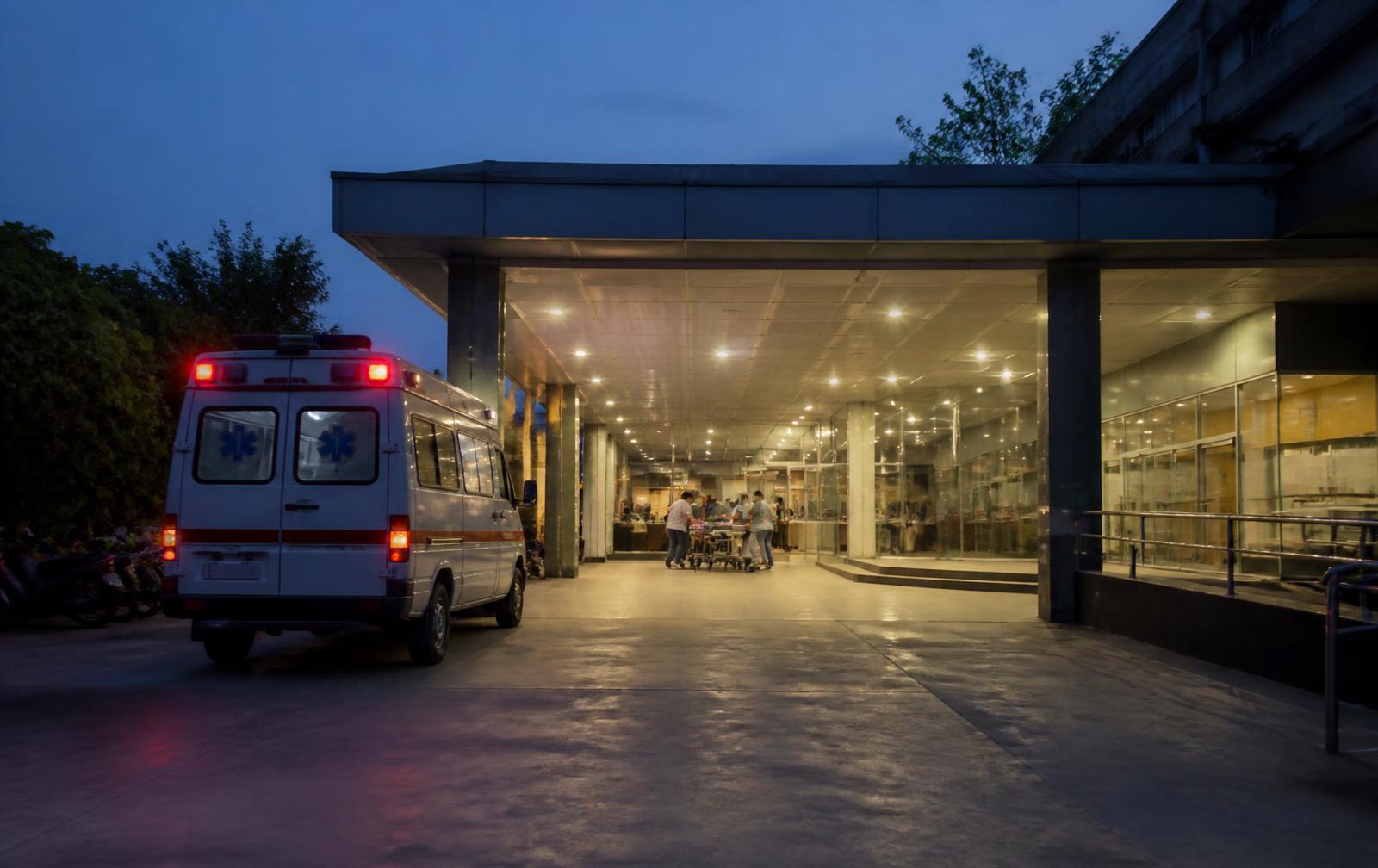
Emergency and ambulance services
Our casualty is staffed at every hour by a duty doctor and trained nursing team, with a resuscitation bay, ventilator support and immediate access to the operation theatre, ICU and imaging.
Come to the emergency department if you see any of these
These situations should not wait for an outpatient appointment.
Chest pain or pressure
Especially with sweating, breathlessness or pain spreading to the arm or jaw. Do not wait to see whether it settles.
Sudden weakness or slurred speech
Face drooping, weakness on one side or difficulty speaking may be a stroke. Treatment works best within the first few hours.
Difficulty breathing
Struggling for breath, blue lips, or a child pulling in the chest while breathing.
Serious injury or road accident
Heavy bleeding, a suspected fracture, a head injury, or loss of consciousness after a fall.
Uncontrolled bleeding
Bleeding that does not stop with firm pressure, or bleeding in pregnancy.
Fits, poisoning or burns
Any convulsion, suspected poisoning or snake bite, and burns beyond a small area.
What to do before you reach us
- 1
Call our emergency number and say where you are and what has happened — the team prepares while you travel.
- 2
Do not give food or water to an unconscious or drowsy patient.
- 3
For bleeding, press firmly on the wound with a clean cloth and keep the part raised.
- 4
For a suspected fracture, do not straighten the limb; support it as it lies.
- 5
Bring the patient's medicines, previous prescriptions and any hospital records if these are within reach.
- 6
In a road accident, do not move a patient with neck or back pain unless there is immediate danger.
Reaching the casualty
- Separate emergency entranceThe casualty has its own covered porch on the side of the building, apart from the main outpatient entrance. Near Satipur Chauraha, just before Pilibhit Bypass Road.
- Drop-off and parkingVehicles can pull up directly at the porch to drop a patient. Attendants can then park in the visitor area behind the building.
- Triage on arrivalPatients are assessed in order of severity rather than arrival, so the most critical are treated first. Registration is completed by an attendant while treatment begins.