IVF & Fertility Centre

Fertility care for couples in Bareilly

Both partners are evaluated before any treatment is advised, and the simplest option that fits the diagnosis is offered first. We explain what your reports show, what each treatment involves and what it will cost — and we do not promise outcomes.

A stepped, evidence-led approach

The IVF and Fertility Centre evaluates and treats couples who have not been able to conceive. Both partners are investigated — not only the woman — because male factors account for a substantial share of infertility and are usually the quickest to identify.

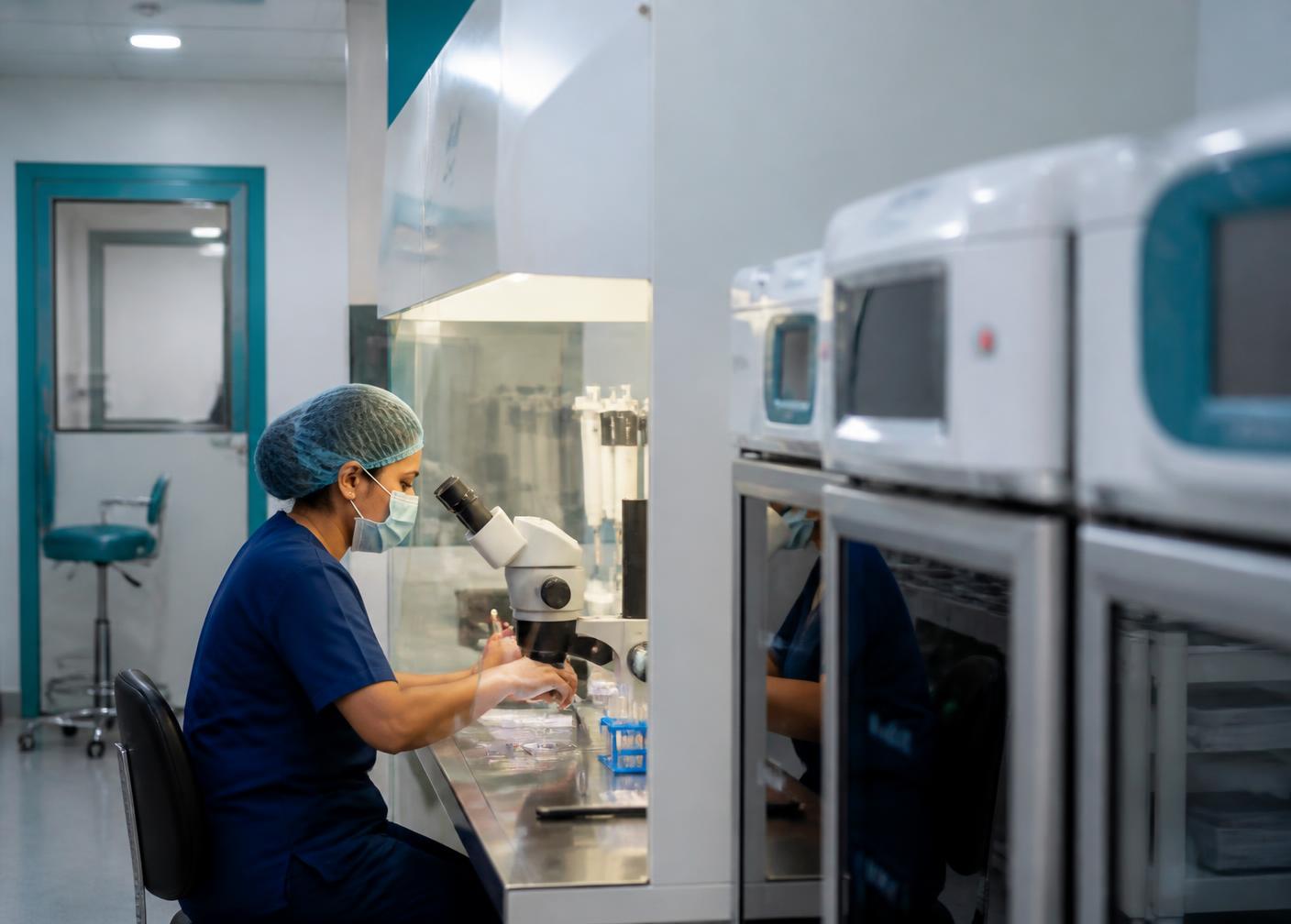
Treatment is stepped. Where the tubes are open and the sperm count is adequate, timed cycles or IUI are offered first. IVF and ICSI are advised when the diagnosis calls for them, supported by an embryology laboratory with blastocyst culture, vitrification and frozen embryo transfer.

We do not quote success rates as a promise. Every couple is told honestly what their particular reports suggest, what the treatment can and cannot do, and what it will cost before a cycle begins.

Embryologist working at a laminar flow station in the IVF laboratory

Fertility services

Treatments we offer, explained simply

Every treatment below is described in plain language. Which of them applies to you depends entirely on your investigations.

Core treatments

IVF — In Vitro Fertilisation

Eggs and sperm are combined in the laboratory and the resulting embryo is placed in the uterus.

Medicines are used for about ten to twelve days so that several eggs mature together. The eggs are collected under short anaesthesia, fertilised in the laboratory with the partner's sperm, and grown for a few days. One embryo is then placed in the uterus through a thin catheter — a painless step that does not need anaesthesia.

IUI — Intrauterine Insemination

Washed, concentrated sperm is placed directly into the uterus around the time of ovulation.

IUI is the simplest assisted treatment and is often tried first when the tubes are open and the sperm count is adequate. The cycle is tracked by ultrasound, and the procedure itself takes a few minutes in the clinic without anaesthesia.

ICSI — Intracytoplasmic Sperm Injection

A single sperm is injected directly into an egg under a microscope.

ICSI is used when the sperm count or motility is low, when sperm have been retrieved surgically, or when fertilisation did not occur in a previous IVF cycle. Everything else in the cycle is the same as IVF.

TESE — Testicular Sperm Extraction

Sperm is retrieved directly from testicular tissue when none is present in the semen.

A minor day-care procedure under local or short anaesthesia. Retrieved sperm is used with ICSI, and surplus tissue can be frozen for later cycles.

PESA — Percutaneous Epididymal Sperm Aspiration

Sperm is drawn with a fine needle from the epididymis when the passage is blocked.

Used where sperm production is normal but the outflow is obstructed, for example after infection or vasectomy. It is quicker and less invasive than TESE and is also combined with ICSI.

Egg Donation

Eggs from a screened donor are used when a woman's own eggs are not usable.

Considered after premature ovarian failure, repeated poor response or certain genetic conditions. Donor screening, consent and documentation follow ART regulations, and counselling is provided before the decision.

Embryo Donation

A donated embryo is transferred when both egg and sperm factors are involved.

An option for couples where neither partner's gametes can be used. The legal and consent process is explained in full before treatment is planned.

Advanced laboratory

Blastocyst Culture

Embryos are grown in the laboratory for five days instead of three.

Growing embryos to the blastocyst stage lets the embryologist see which ones are developing best, so that a single healthy embryo can be selected for transfer instead of two or three.

PGT-A — Preimplantation Genetic Testing for Aneuploidy

Embryos are checked for the correct number of chromosomes before transfer.

A few cells are taken from a blastocyst and tested. It is usually considered after repeated implantation failure, repeated miscarriage, or where maternal age makes chromosomal errors more likely. It is not required in every cycle.

PGT-M — Preimplantation Genetic Testing for Monogenic Disease

Embryos are tested for a specific inherited condition that runs in the family.

Where both parents carry a gene for a condition such as thalassaemia, PGT-M identifies embryos that are unaffected. It requires genetic counselling and preparation before the IVF cycle begins.

ERA — Endometrial Receptivity Analysis

A test that identifies the window when the uterine lining is ready to accept an embryo.

A small sample of the uterine lining is analysed to check whether the standard transfer day is right for you. It is considered when good embryos have failed to implant in earlier cycles.

PRP — Platelet Rich Plasma therapy

A concentrate prepared from your own blood, used to support a thin uterine lining or low ovarian response.

A small quantity of blood is processed to concentrate the platelets, which is then instilled into the uterus or ovary. It is an adjunct offered in selected cases, and its role is explained honestly during counselling.

Preservation

Vitrification

Ultra-rapid freezing that preserves eggs and embryos without ice crystal damage.

Vitrification is the technique behind all modern freezing in the laboratory. It allows surplus embryos from a cycle to be stored and used later without repeating stimulation.

Embryo Freezing

Surplus good-quality embryos are stored for a future transfer.

If a fresh transfer is not advisable, or if embryos remain after transfer, they are vitrified and stored. A frozen embryo transfer is a much simpler cycle than a full IVF cycle.

Egg Freezing

Unfertilised eggs are collected and stored for use later.

Chosen for medical reasons such as before cancer treatment, or where childbearing is being deferred. The collection process is the same as the first half of an IVF cycle.

Assessment & support

Hysteroscopy

A thin telescope is used to look inside the uterus.

It shows polyps, adhesions, septa or fibroids that can prevent implantation, and many of these can be corrected in the same sitting. It is a day-care procedure.

Laparoscopy

Keyhole examination of the tubes, ovaries and pelvis.

Used where endometriosis, adhesions or tubal disease is suspected. Findings often change the treatment plan, and correctable problems are treated during the same procedure.

Fertility Counselling

A structured discussion of your reports, options, costs and realistic expectations.

Both partners are seen together. We go through what the investigations show, which treatments are appropriate, what each involves, and what it will cost — before any cycle is started. No outcome is promised.

What to expect

The fertility journey, step by step

From the first consultation to the pregnancy test, here is how a treatment cycle usually runs.

  1. 1

    First consultation

    Both partners are seen together. History, previous reports and any earlier treatment are reviewed, and the tests still needed are listed.

  2. 2

    Evaluation

    Hormone profile, ultrasound and follicular study for the woman; semen analysis and, where needed, hormone tests for the man. Hysteroscopy or laparoscopy if indicated.

  3. 3

    Treatment plan and counselling

    The findings are explained together with the options — timed cycles, IUI, IVF or ICSI — along with what each involves, the schedule and the estimated cost.

  4. 4

    Stimulation and monitoring

    Daily injections for about ten to twelve days with ultrasound monitoring every few days to track how the follicles are growing.

  5. 5

    Egg retrieval and fertilisation

    Eggs are collected under short anaesthesia as a day-care procedure and fertilised in the laboratory by IVF or ICSI.

  6. 6

    Embryo transfer

    The embryo is placed in the uterus with a fine catheter. Surplus embryos are vitrified for future use.

  7. 7

    Follow-up

    A pregnancy blood test about two weeks later, followed by a scan and, when the result is positive, transfer of care to our antenatal clinic.

When to see a fertility specialist

  • You have been trying to conceive for a year without success
  • You are over 35 and have been trying for six months
  • You have had two or more miscarriages
  • A semen analysis has come back abnormal
  • You have PCOS, endometriosis or known tubal disease

Fertility conditions we treat

  • Male InfertilityLow sperm count, poor motility or absent sperm. Assessed by semen analysis and hormone testing; ICSI, TESE or PESA may be advised.
  • Female InfertilityOvulation problems, blocked tubes, endometriosis or uterine factors, evaluated with scans, hormone profiles and hysteroscopy.
  • Recurrent Pregnancy LossTwo or more miscarriages, investigated for hormonal, uterine, immune and genetic causes before planning the next pregnancy.

Questions couples ask

Do we both need to be tested?
Yes. A semen analysis is quick and inexpensive, and testing only one partner regularly delays the right diagnosis. We ask both partners to attend the first consultation together.
Is IVF the first treatment you offer?
No. Where the tubes are open and the sperm parameters are reasonable, timed cycles or IUI are tried first. IVF is advised when the reports indicate it.
Is egg retrieval painful?
It is done under short anaesthesia as a day-care procedure and you go home the same day. Mild bloating or cramping for a day or two afterwards is common.
Can you guarantee a pregnancy?
No clinic honestly can. Outcomes depend on age, diagnosis and embryo quality. We explain what your specific situation makes likely and never quote a guarantee.

Emergency? Do not wait for an appointment.

Our casualty is staffed round the clock and our ambulances are on call across Bareilly city and the surrounding districts. Call first if you can — the team will be ready when you arrive.

EmergencyAmbulanceAppointment